New insights from the AFi and CDP show company progress on deforestation
21 juillet 2026
Tackling Deforestation to Build Resilience examines disclosures on deforestation-and conversion-free supply chains and corporate climate action
The AFi and CDP today released new data and analysis on the progress companies are making to achieve agricultural and forestry commodity supply chains that are deforestation- and conversion-free.
Tackling Deforestation to Build Resilience features aggregated findings based on corporate disclosures made through CDP in 2025. A total of 1,583 companies disclosed on their management of commodity-driven deforestation, the highest number of that have done so. The new brief is a follow-up to Time for Transparency, which analysed disclosures made in 2023.
Companies are providing more—and better—disclosures on deforestation
- 647 (41% of the 1,583 total) companies assessed and disclosed on how much of the commodities they produce or source are deforestation- and/or conversion-free.
- This is an increase of 202 companies (or 45%) compared to 2023, when 445 companies did so.
- 275 (17% of the 1,583 total) companies made comprehensive and high-quality disclosures.
- 169 (11% of the 1,583 total) of those making quality disclosures also reported that at least one commodity supply chain was more than 90% deforestation- and/or conversion-free.
- 120 (8% of the 1,583 total) reported all their disclosed supply chains were at least 90% deforestation- and/or conversion-free.
Not all sectors are equal—disclosure rates and qualities vary by commodity
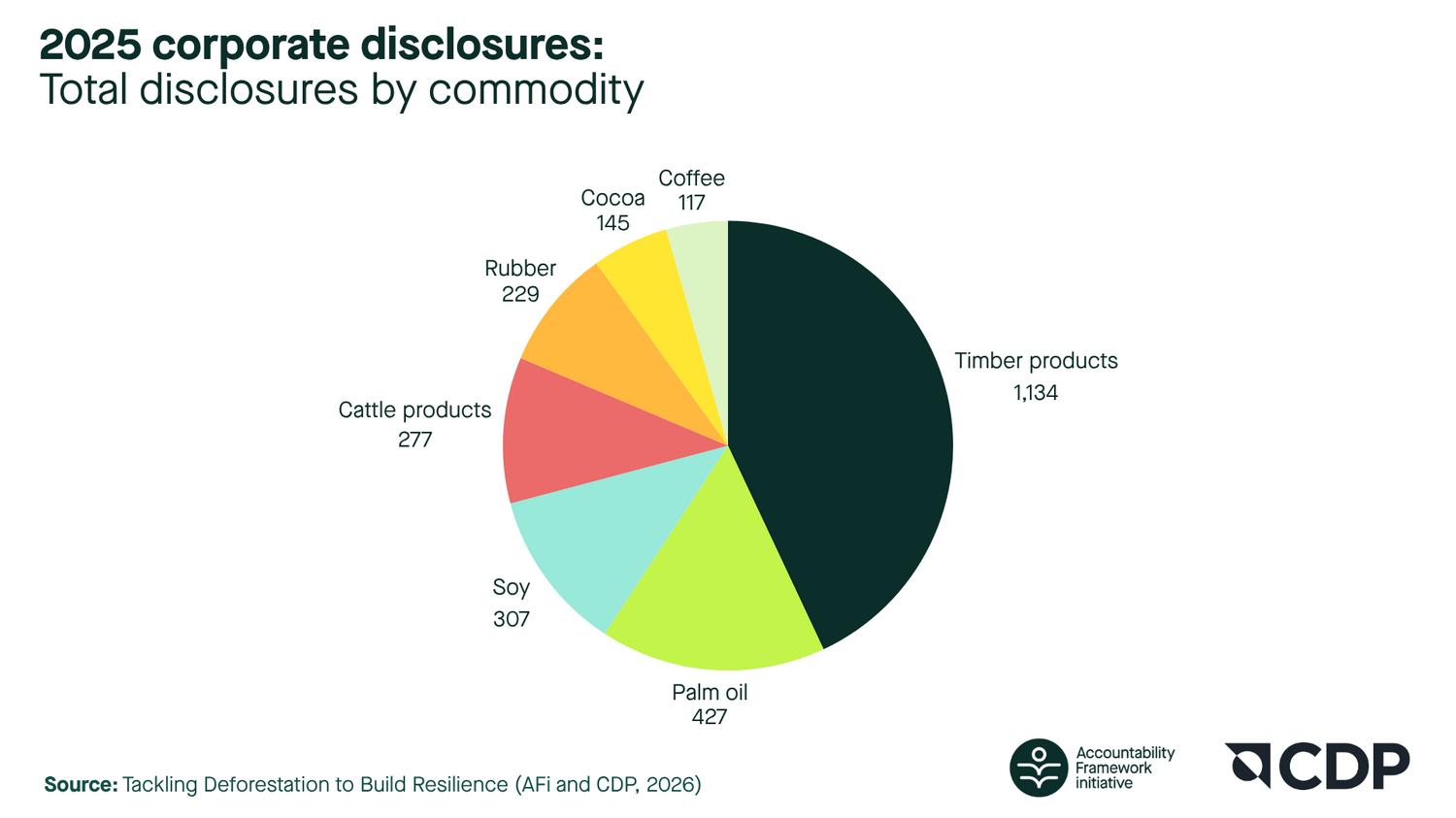
In 2025, companies made a total of 2,636 commodity-specific supply chain disclosures through CDP. The timber sector represents the largest proportion of disclosures, accounting for 43% (1,134). Palm oil accounts for 16% (427), soy for 12% (307), cattle products for 11% (277), rubber for 9% (229), cocoa for 6% (145), and coffee for 4% (117).
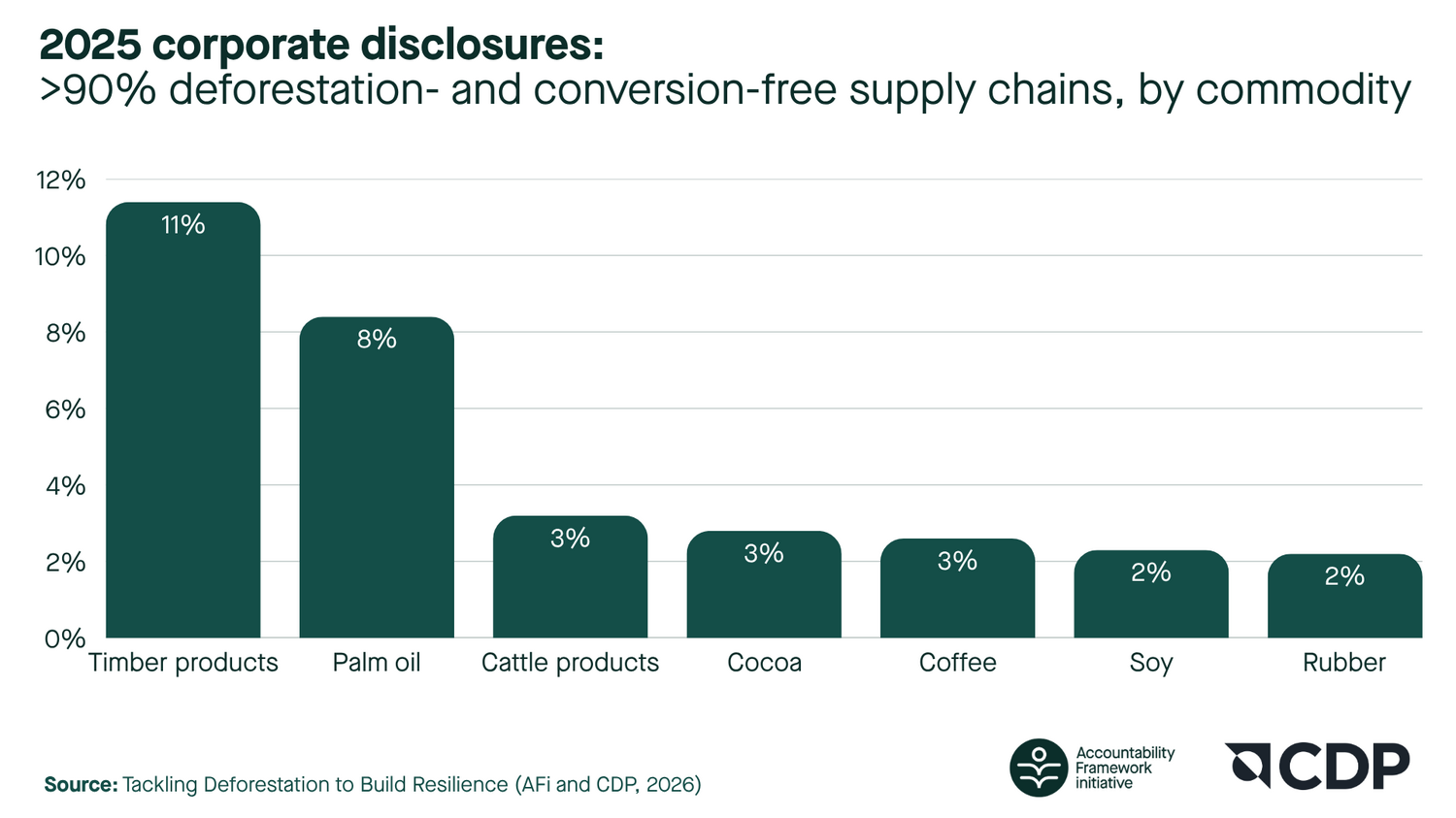
The timber sector also has the highest rate of high-quality disclosures that report >90% of disclosure volumes as deforestation-free or deforestation- and conversion-free (11% of all timber disclosures.) This is followed by 8% of palm oil disclosures, 3% of cattle product disclosures, 3% of cocoa disclosures, 3% of coffee disclosures, 2% of soy disclosures, and 2% of rubber disclosures.
“A handful of top-performing companies are already reporting that their businesses are free or almost free of deforestation or conversion,” said CDP Head of Land Tomasz Sawicki. “These disclosure leaders are taking decisive action by managing risks and protecting their supply chains. Governments, finance, and land-intensive sectors can draw on these examples to help the majority still transitioning their production and procurement practices to protect the natural assets we all depend on.”
Slow progress on land-related emissions reductions targets
For most companies operating in land intensive sectors, achieving deforestation-free supply chains is the single most important action they can take to lower their greenhouse gas emissions. To mitigate climate risks, many companies have set Forest, Land and Agriculture (FLAG) targets via the Science Based Targets initiative (SBTi).
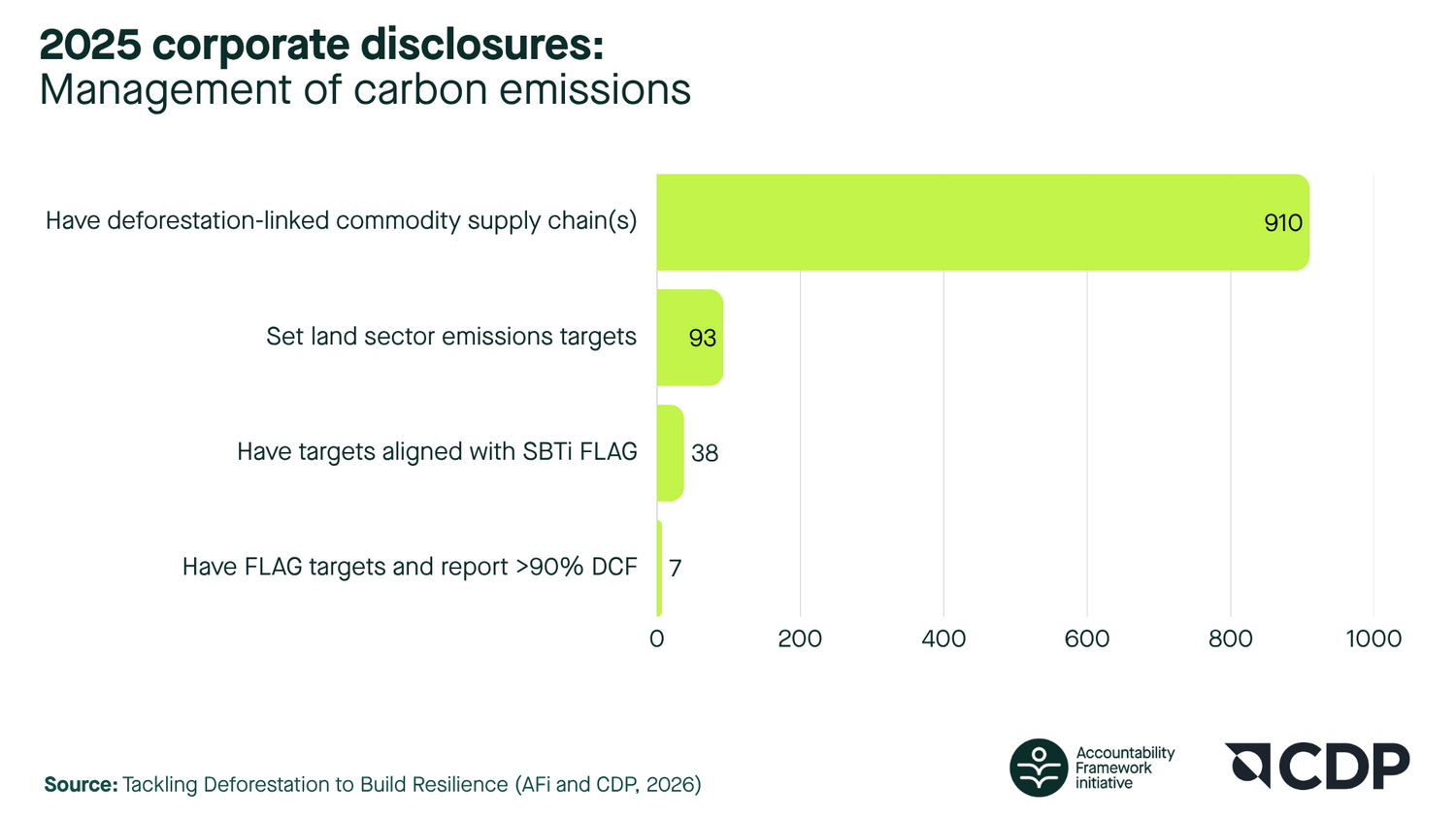
A total of 910 companies that disclosed through CDP on management of carbon emissions derive significant revenue from one or more deforestation-linked supply chain. Of those companies—for which it is business critical to manage deforestation—only 93 (10%) have set organisation-wide land sector emissions reduction targets. Less than half of those (38) have or will be submitting to the SBTi for validation as FLAG targets. Unfortunately, even fewer companies—only 7—have both committed to robust FLAG emissions reduction targets and report supply chains that are at least 90% deforestation- and/or conversion-free (DCF).
“For companies managing deforestation risks, addressing land use change is often the most meaningful way to reduce their greenhouse gas emissions,” said AFi Lead Scientist Leah Samberg. “Setting a FLAG target through the SBTi is the clearest indication that a company intends to meaningfully reduce deforestation and conversion of other ecosystems as a central part of its climate goal.”
Monitoring systems matter
Companies that are serious about eliminating deforestation from their supply chains need robust policies, procedures, and monitoring systems. The Accountability Framework provides a roadmap for setting supply chain goals, implementing them throughout their operations and supply chains, and reporting on progress. It also outlines good practices for monitoring and controlling deforestation and conversion, including assessing deforestation- and conversion-free status at the production unit or sourcing area level, or via certification schemes.
“In order to credibly assess and disclose progress towards achieving deforestation-free supply chains, companies must be able to accurately monitor land use change associated with the products they produce or source,” said Samberg. “The Accountability Framework provides guidance on how companies can assess deforestation and determine compliance with deforestation-free commitments and policies, which prepares them for high-quality reporting.”
Many companies use a combination of monitoring approaches, including monitoring farms and plantations, monitoring of sourcing areas, or using third party certification programs that provide assurance of deforestation-free production. In the 2025 disclosures through CDP, third-party certification systems remained the most common method for all sectors except cattle. Many companies, particularly those in the cattle sector, also rely on direct monitoring of sourcing areas and individual production units.
The 2026 disclosure window is now open
Leading companies have set targets to eliminate deforestation from their supply chains by 2025. For many of them, this year’s disclosures will communicate the extent to which that target has been met, or will highlight progress that still needs to be made. As stakeholders look to determine whether companies are meeting their goals, the current CDP disclosure cycle will be scrutinised more closely than ever before. For companies still seeking to achieve no-deforestation goals, clear reporting can both communicate progress and uncover where supply chain monitoring and control systems need to be improved.
To foster greater transparency, the AFi encourages all companies with deforestation-linked supply chains to disclose the deforestation- and conversion-free status of their supply chains. As demand for responsible, transparent supply chain grows, every disclosure counts.
Join our webinar
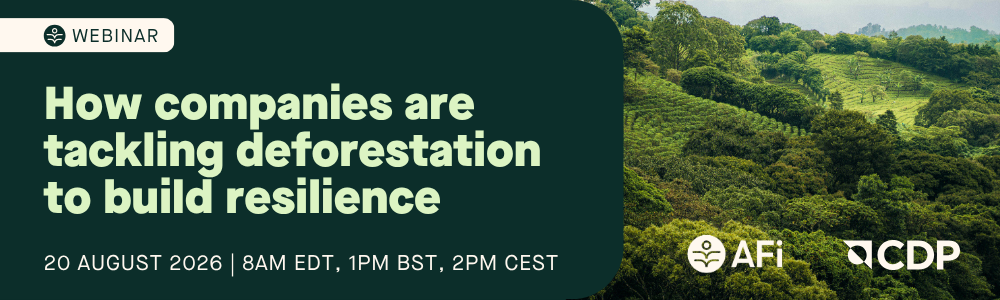
On 20 August 2026, the AFi and CDP will host a webinar with speakers from Danone, Golden-Agri Resources, and MBRF. It will explore how companies can produce and source agricultural and forestry commodities in ways that protect forests and lower corporate climate impacts.