AFi-CDP Brief: Tackling Deforestation to Build Resilience
21 julho 2026
Joint AFi-CDP analysis of 2025 corporate disclosure data on deforestation- and conversion-free commodities
New data released by the Accountability Framework initiative (AFi) and CDP offers up-to-date insights on corporate progress towards achieving deforestation- and conversion-free commodity supply chains.
Tackling Deforestation to Build Resilience analyses 2,636 commodity-specific disclosures made by 1,583 companies. It is a follow up to the AFi-CDP Time for Transparency report, published in 2024.
Key findings
- 647 (41% of the 1,583 total) companies assessed and disclosed on how much of the commodities they produce or source are deforestation- and/or conversion-free.
- 275 (17% of the 1,583 total) companies made comprehensive and high-quality disclosures.
- 169 (11% of the 1,583 total) of those making quality disclosures also reported that at least one commodity supply chain was more than 90% deforestation- and/or conversion-free.
- 120 (8% of the 1,583 total) reported all their disclosed supply chains were at least 90% deforestation- and/or conversion-free.
Performance by commodity sector
The timber sector represents the largest proportion of disclosures, accounting for 43% (1,134). Palm oil accounts for 16% (427), soy for 12% (307), cattle products for 11% (277), rubber for 9% (229), cocoa for 6% (145), and coffee for 4% (117).
The timber sector also has the highest rate of high-quality disclosures that report >90% of disclosure volumes as deforestation-free or deforestation- and conversion-free (11% of all timber disclosures.) This is followed by 8% of palm oil disclosures, 3% of cattle product disclosures, 3% of cocoa disclosures, 3% of coffee disclosures, 2% of soy disclosures, and 2% of rubber disclosures.
Progress on land-related emissions targets
A total of 910 companies that disclosed through CDP on management of carbon emissions derive significant revenue from one or more deforestation-linked supply chain.
Of those companies—for which it is business critical to manage deforestation—only 93 (10%) have set organisation-wide land sector emissions reduction targets. Less than half of those (38) have or will be submitting to the SBTi for validation as FLAG targets.
Unfortunately, even fewer companies—only 7—have both committed to robust FLAG emissions reduction targets and report supply chains that are at least 90% deforestation- and/or conversion-free.
Join our webinar
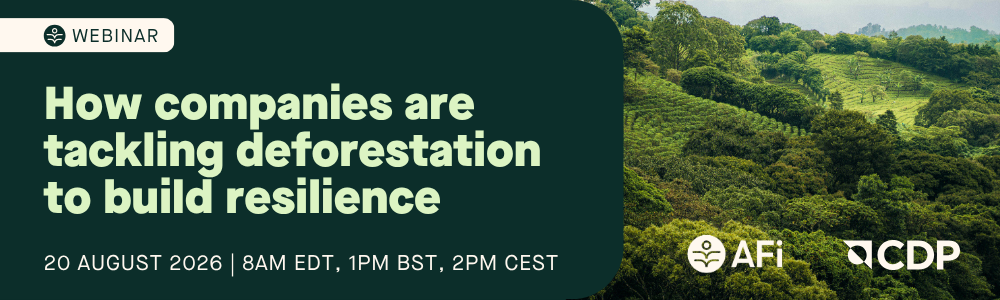
On 20 August, the AFi and CDP will host a webinar with speakers from Danone, Golden Agri-Resources, and MBRF. It will explore how companies can produce and source agricultural and forestry commodities in ways that protect forests and lower corporate climate impacts.
Join our webinar
On 20 August, the AFi and CDP will host a webinar with speakers from Danone, Golden Agri-Resources, and MBRF. It will explore how companies can produce and source agricultural and forestry commodities in ways that protect forests and lower corporate climate impacts.