Forest 500 data shows regulation is driving corporate action on key supply chains
14 April 2026
Global Canopy’s latest Forest 500 report reveals how the EU Deforestation Regulation is driving corporate action to address deforestation across key commodity supply chains.
New data from Global Canopy, an Accountability Framework initiative (AFi) Coalition member, shows that the incoming EU Deforestation Regulation (EUDR) has already steered business expectations, galvanised investment and driven supply chain action by some of the most influential businesses that contribute to global deforestation.
- In 2025, publicly reported evidence on traceability mechanisms – a key EUDR requirement – increased for eight of the nine Forest 500 commodities.
- Of the 500 companies assessed, 45 reference the EUDR in relation to action on traceability.
The EUDR requires companies to show that EU imports and exports of these commodities are deforestation-free, with non-compliance carrying fines of at least 4% of a company’s EU turnover.
Beyond regulation, some companies prioritise efforts to eliminate deforestation and ecosystem conversion from their supply chains due to pressure from customers and investors. This is most notable in companies sourcing or producing palm oil. After two decades of high-profile consumer campaigns and NGO pressure, these companies perform better than companies exposed to other commodities.
- 76% of companies exposed to palm oil have deforestation-free commitments, compared with just 29% involved with leather.
- Palm oil scores the best on implementing traceability mechanisms, with 50% of companies reporting a system in place. At the lowest end of the scale is coffee with just 18% of companies reporting traceability systems.
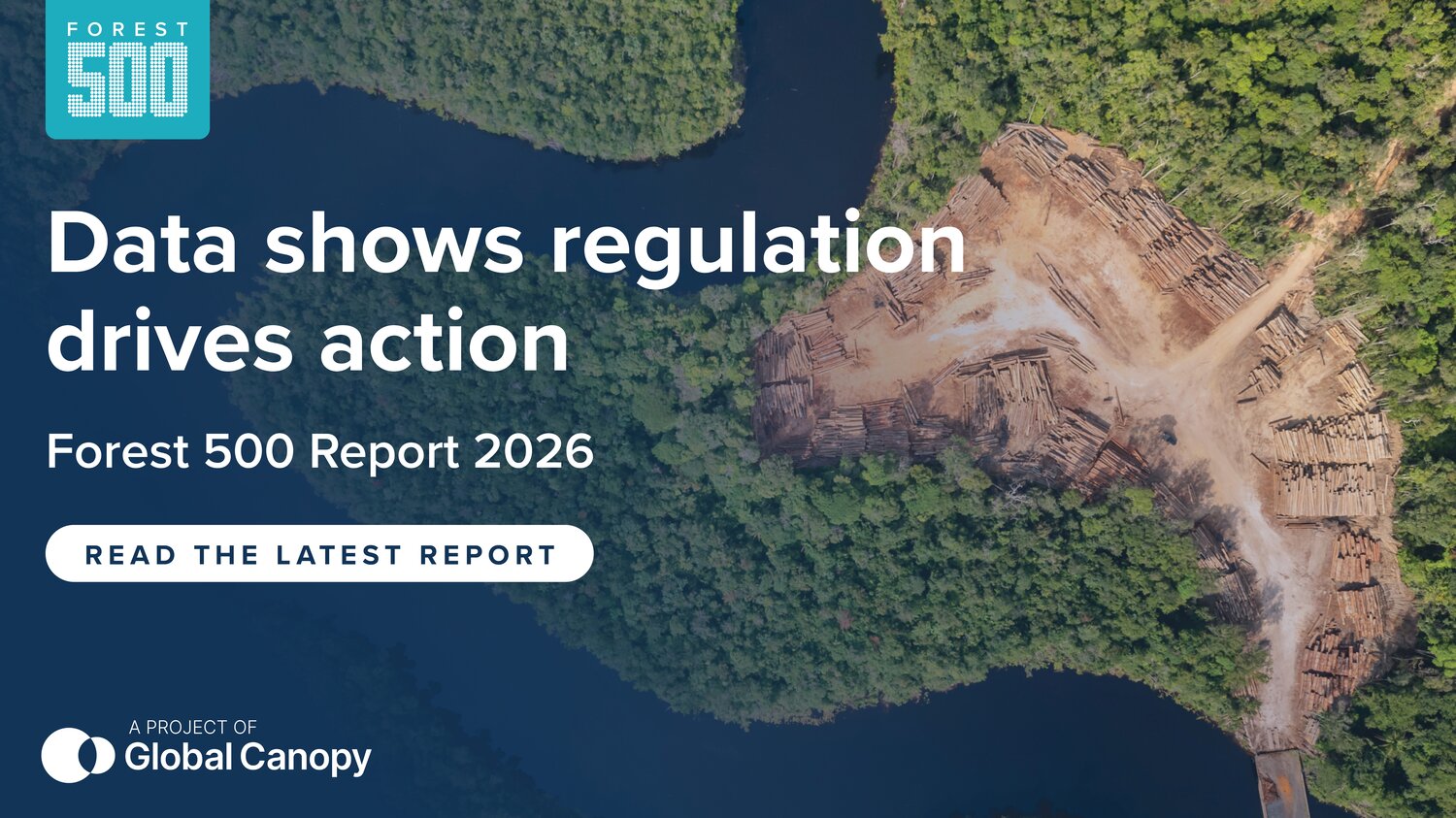
Regulation drives action, but progress remains uneven
The data points to companies gearing up for the prospect of the EUDR even before its implementation. 68 (14%) of the 500 companies cite the EUDR in public documents related to action on tackling deforestation. As Forest 500 data relies solely on public disclosures by companies, this is likely just the tip of a bigger iceberg of corporate decisions taken in private.
This, alongside the data on traceability, shows the positive influence that regulation can have and why sustained leadership is so urgently needed from governments in key markets like the EU and the UK. Lawmakers must stay the course and not let lobbying derail the evident impact the EUDR is having on the most influential businesses in forest risk supply chains.
In 2025, the actions of a handful of leading companies showed that commodity-driven deforestation is a solvable crisis. But as in previous years, too few companies are acting with enough urgency.
- Only 146 (29%) of the companies have made commitments for all the Forest 500 commodities to which they are exposed – a small increase from 27% last year.
- Since the 2024 assessment, 14 (3%) companies backtracked on deforestation action by dropping deforestation commitments, downgrading commitment wording and/or withdrawing from third-party certification schemes for at least one commodity.
A snapshot of company (in)action
The Forest 500 companies fall into three categories of performance:
- Leaders: 19 (4%) companies have strong deforestation commitments for all the commodities they are assessed for and report significantly stronger implementation than most. The presence of downstream companies in this category shows that complex supply chains are not an excuse for inaction.
- Late majority: 313 (63%) companies have signalled some intent to tackle deforestation but have made only partial commitments and/or achieved weak progress on implementation. 132 (42%) of the 313 late majority companies reported progress on implementation in 2025 compared to what they reported in 2024.
- Laggards: 168 (33%) companies have no deforestation or ecosystem conversion commitments for any commodity. Among the companies with no commitments, 24 have failed to publish a deforestation commitment in the 12 years since the Forest 500 assessment began in 2014.
Consistent methodology, aligned with the Accountability Framework
Since 2020, the Forest 500 company assessment methodology has been aligned with the Accountability Framework. This alignment provides consistency and clarity, as companies know that their performance will be evaluated in line with the Framework. Likewise, by following the Framework, companies can improve their Forest 500 scores over time.
The 2025 Forest 500 assessment methodology consists of five sections: Commitment Strength, Implementation, Reporting, Verification and Associated Human Rights Abuses. Specific metrics in each section are informed by and aligned with the AFi’s Common Methodology for Assessment of Progress Towards Deforestation-and Conversion-Free Supply Chains.
This methodology has been co-developed with the AFi and leading assessment and disclosure initiatives. It provides standardised metrics to assess company progress towards eliminating deforestation, conversion and human rights abuses from commodity supply chains.
About Forest 500
Global Canopy’s Forest 500 is an annual assessment of the 500 companies with the greatest influence on deforestation through their sourcing and production of key commodities.
The 12th annual Forest 500 report, Data shows regulation drives action, examined over 270,000 public data points to assess actions taken by 500 companies in the global trade of the nine forest risk commodities covered by the EUDR: beef, cocoa, coffee, leather, palm oil, pulp and paper, rubber, soy and timber. The report is available to download from the Forest 500 website.